The four things that matter
A casino cashier will happily show you a dozen logos and tell you almost nothing useful about any of them. To cut through it, forget the branding and judge every method on the same four questions. Get clear on these and choosing becomes easy, because different people weight them differently.
Speed. There are really two clocks here, not one. Deposits are near-instant on almost everything, so they rarely decide the choice. Withdrawals are where methods separate: the gap between getting paid in minutes and getting paid in three business days is entirely down to the rail you picked, not the casino's slogan.
Fees. A good casino charges nothing to deposit or withdraw, so the fees that bite are usually external, currency conversion when you play in a currency your account is not held in, a network fee on a blockchain, or your bank's own charge on an international transfer. Small percentages add up fast if you deposit often.
Limits. Every method has a floor and a ceiling. Cards and e-wallets tend to suit modest, everyday amounts; bank transfers and crypto handle larger sums more comfortably. If you play at higher stakes, a low withdrawal ceiling can quietly throttle even a fast method into a multi-day drip.
Privacy. How much of a paper trail a method leaves, and how much identity detail it exposes, varies widely. Some players do not care; others very much do. It is worth knowing where each method sits before you commit.
E-wallets
E-wallets such as Skrill, Neteller and PayPal sit between your bank and the casino, and that middle layer is exactly why they are so popular. You load the wallet once, then move money in and out of casinos without ever handing your card or bank details to the operator directly. Deposits are instant, and withdrawals are among the fastest of any method because settlement to the wallet is effectively immediate, leaving the casino's approval time as the only real wait.
The trade-offs are modest but real. Wallets sometimes charge a small fee to withdraw to your bank or to convert currency, and a handful of casinos exclude e-wallet deposits from welcome-bonus eligibility, so always check the promotion terms before you fund. Limits tend to comfortably cover recreational play but can feel tight for high rollers. On privacy, e-wallets are a genuine step up from cards: the casino sees a wallet, not your bank account, even though the wallet provider itself still knows exactly who you are.
Instant bank transfer (Trustly/Pay-by-bank)
Instant bank transfer, marketed as Trustly, Pay-by-bank, PayID or open banking depending on where you live, connects directly to your online banking and moves money in real time without cards or a separate wallet. You log in through your own bank's secure screen, approve the payment, and you are done. There is no new account to open and no third-party balance to top up, which is why it has become the default in several regulated markets.
Speed is excellent in both directions, though withdrawals can occasionally be nudged into the next banking batch window during nights and weekends, which is a bank behaviour rather than a casino one. Fees are usually zero because you are using existing bank rails. Limits are generally high, making this a strong pick for larger balances. Privacy is the weak spot: the money moves straight between your named bank account and the casino, so it leaves the clearest paper trail of any method here. For most players that is a non-issue; for the privacy-conscious it is the deciding factor.
Cards
Debit and credit cards from Visa and Mastercard remain the method most people reach for first, purely because everyone already has one. Deposits are instant and the process is familiar, which counts for a lot if you just want to play without setting anything up. For getting money in, cards are hard to fault.
Getting money out is a different story, and it is where cards consistently disappoint. Card withdrawals travel back through the card schemes and your issuing bank, a route that can take anywhere from a few hours to three business days no matter how quickly the casino releases the funds. Credit-card gambling deposits are banned outright in some markets, and even where allowed can be treated as a cash advance with a fee. Currency conversion charges are common if the casino bills in a currency your card is not held in. On privacy, cards leave a full statement trail and expose your card number to the operator, so they sit at the bottom of the pile.
Crypto & stablecoins
Cryptocurrency moves money directly from your own wallet to the casino with no bank in the middle, which removes the single most common cause of blocked or delayed gambling payments. Both deposits and withdrawals are typically fast, from seconds on newer chains to under an hour on Bitcoin, and the only cost is the network fee, which is fixed by the chain rather than scaled to your amount. Limits are usually generous, and privacy is the highest of any method, since you generally sign up with little more than an email.
The important distinction inside this category is between volatile coins and stablecoins. Bitcoin and Ethereum can change value between the moment you deposit and the moment you cash out, which complicates budgeting and clearing a bonus. Stablecoins such as USDT and USDC are pegged to the dollar, so the amount you put in is the amount you take out, giving you crypto's speed and privacy without the price swings. The genuine catch with all crypto is that on-chain transactions are irreversible: send to the wrong address or over the wrong network and the money is almost always gone for good, so double-check both before you confirm. Our crypto casinos guide goes deeper on picking coins and wallets.
Which method for which player
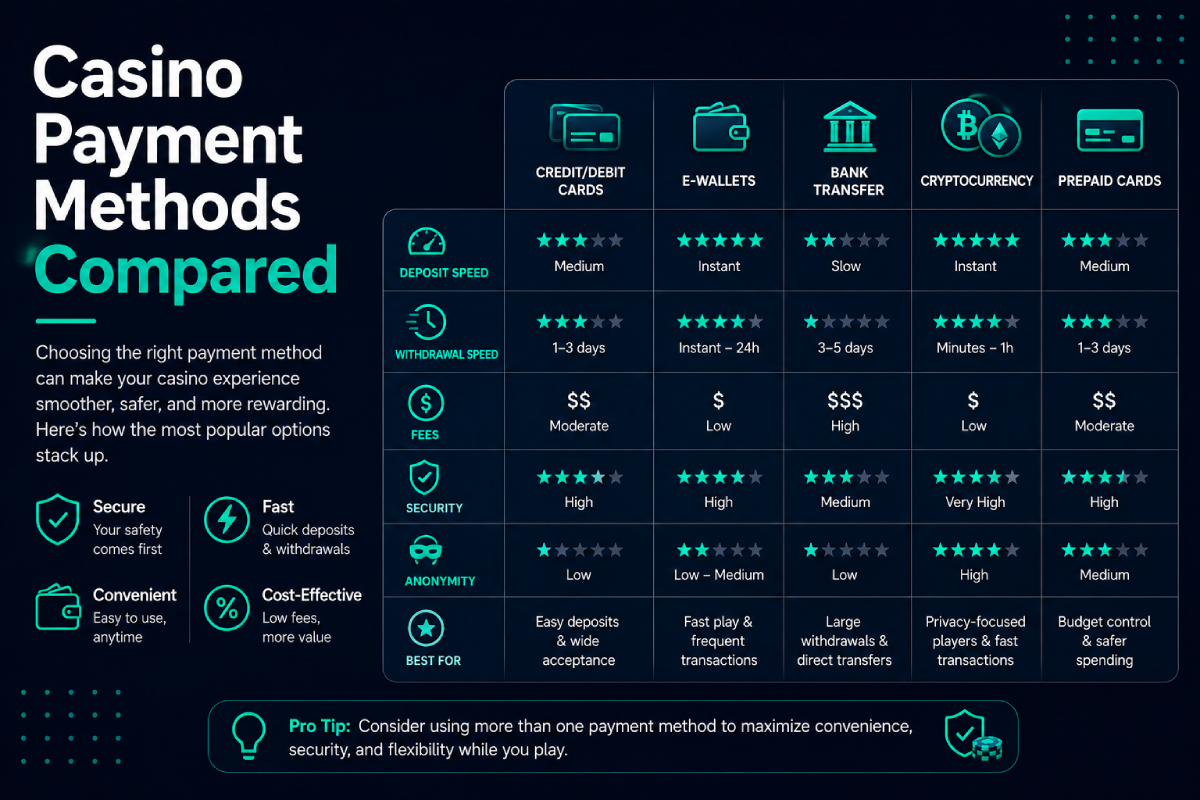
There is no single best payment method, only the best one for how you actually play. Weigh the four factors against your own priorities, and the table below against the shortlist, then pick the method that wins on the factor you care about most.
| Method | Deposit speed | Withdrawal speed | Typical fee | Privacy | Notes |
|---|---|---|---|---|---|
| E-wallets | Instant | Seconds to a few hours | None to small conversion fee | Medium | Fast and easy; may be excluded from some bonuses |
| Instant bank transfer | Instant | Minutes to a few hours | Usually none | Low | High limits; clearest paper trail |
| Cards | Instant | Few hours to 3 business days | Possible conversion or cash-advance fee | Low | Everyone has one; slow to cash out |
| Crypto (BTC, ETH) | Seconds to ~1 hour | Seconds to ~1 hour | Network fee only | High | Fast and private; price can move during play |
| Stablecoins (USDT, USDC) | Seconds to minutes | Seconds to minutes | Low network fee | High | Crypto speed without the price swings |
In short: if you want the simplest start, a card gets you playing in seconds, just do not rely on it to pay you back quickly. If you want a fast, tidy all-rounder, an e-wallet is the sweet spot for most recreational players. If you play larger amounts and do not mind the paper trail, instant bank transfer offers speed and high limits with no fees. And if speed and privacy top your list, stablecoins give you the best of crypto without the volatility headache. Whatever you choose, complete your identity checks early, because an unverified account will stall even the fastest method at your first withdrawal.
FAQ
Which casino payment method is fastest for withdrawals?
Stablecoins and e-wallets are the quickest, usually clearing in seconds to a few minutes once the casino approves the request, because settlement is near-instant. Instant bank transfer is close behind. Cards are the slowest common option and can take up to three business days regardless of how fast the casino itself releases the money.
Do casinos charge fees on deposits or withdrawals?
A well-run casino charges nothing at its end. The fees that actually bite are external: currency conversion when you play outside your account currency, a blockchain network fee on crypto, or your own bank's charge on certain transfers. Cards can also attract a cash-advance fee if a deposit is treated as one by your issuer.
What is the difference between crypto and stablecoins for gambling?
Both move directly from your wallet with high speed and privacy, but volatile coins like Bitcoin and Ethereum can change value between deposit and cash-out, which complicates budgeting and bonus wagering. Stablecoins such as USDT and USDC are pegged to the dollar, so the amount you deposit is the amount you withdraw, giving you the speed without the price swings.
Which payment method offers the most privacy?
Crypto and stablecoins offer the most, since you typically sign up with little more than an email and no bank sits in the middle. E-wallets are a middle ground, shielding your bank details from the casino. Cards and instant bank transfer leave the clearest paper trail because they link directly to your named bank account.